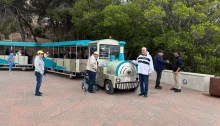
Valletta, Malta 4/13/25

Malta’s rich history began with Sicilian farmers around 5900 BCE. It saw significant civilizations, including the Phoenicians and Romans, and was influenced by Arabs and Norman rulers. The Knights of St. John transformed the island into a fortress. Malta gained independence in 1964 and joined the EU in 2004, showcasing dynamic cultural heritage.

Cartegena, Spain 4/11/25

Cartagena, Spain, founded in 227 BC, has a rich history as a key naval and military base. Originally established by Hasdrubal the Fair, it later became a Roman colony. Today, it features ancient ruins, including a Roman amphitheater. Our visit included a trolley train tour and a local parade, ending with a prayer in the main church.

Gibraltar – 4/10/25

Gibraltar has a rich history, featuring Neanderthal fossils and influences from the Phoenicians to the Moors. It became a British Overseas Territory in 1713 after the War of the Spanish Succession. Today, it has a stable economy and a population of 30,000. Challenges in family dynamics and exploration during a visit are also highlighted in their experiences.

Arrecife, Lanzarote, Canary Islands 4/8/25

Arrecife, the capital of Lanzarote in the Canary Islands, has a rich and layered history that blends maritime significance, piracy, volcanic activity, and cultural evolution. Lancelotto Malocello, an Italian navigator, is credited with rediscovering the island for Europe in 1312, giving his name to Lanzarote. The Norman nobleman Jean de Béthencourt led the Spanish conquest…

Santa Cruz, Canary Islands 4/7/25

Santa Cruz de Tenerife, the capital of Tenerife in the Canary Islands (Spain), has a rich and fascinating history shaped by its strategic location in the Atlantic Ocean.  Before the Spanish arrived, the island was inhabited by the Guanches, an indigenous people of Berber origin. They lived in small communities and had a tribal society.…